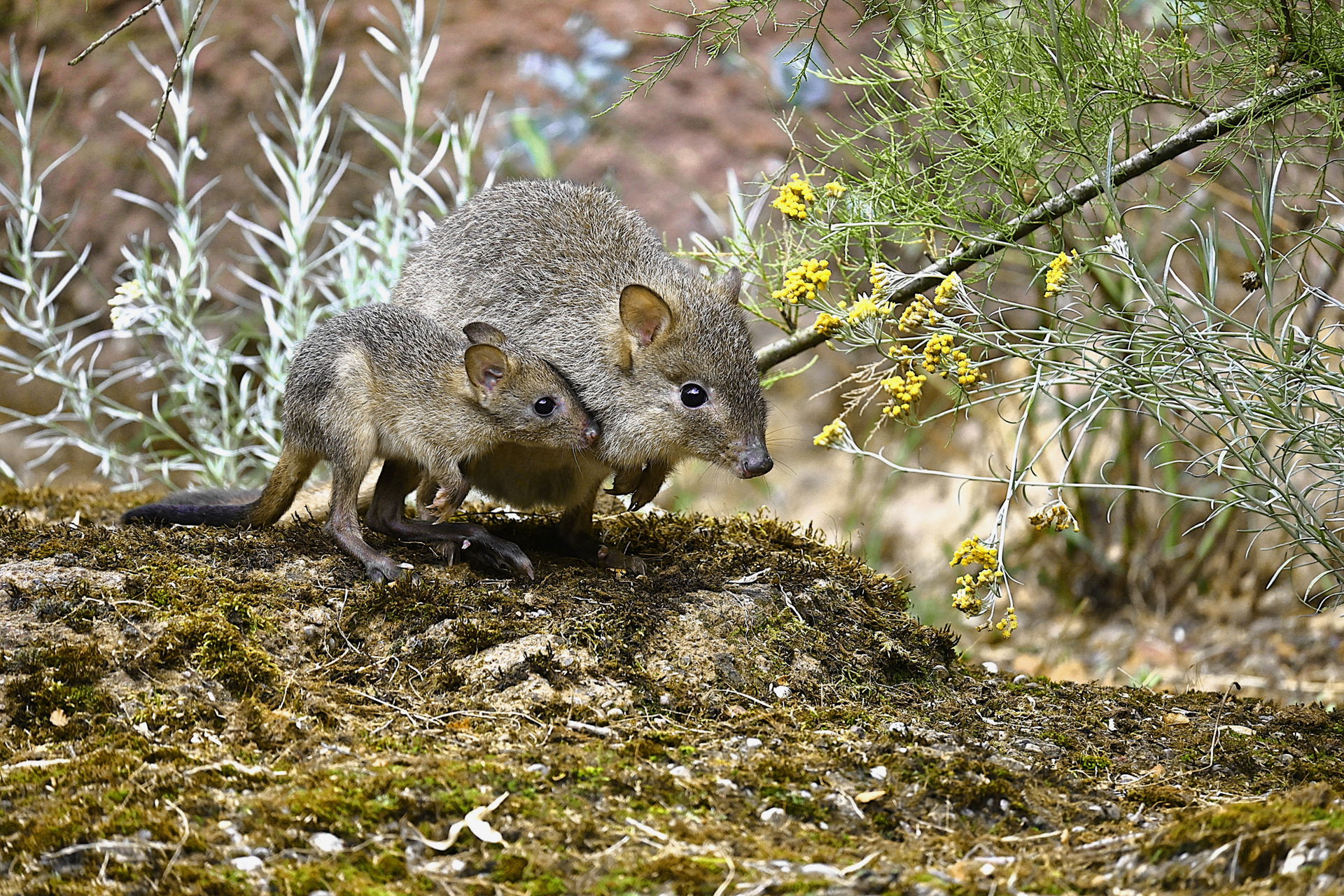
The woylie feeds mainly on the fruiting bodies of underground fungi. Its diet is supplemented by onions, tubers, seeds, insects and resin. It eats the most fungi in summer and autumn. It does not eat any green plant matter, nor does it drink water.
Woylies reproduce all year round. Like their larger kangaroo relatives, they have a delayed birth. Immediately after giving birth, the female mates again. However, the new embryo only begins to develop once the older juvenile has left the pouch. This means that woylies can raise three juveniles at the same time: one unborn, one during time in pouch and the oldest one outside.
This small marsupial used to inhabit 28 of Australia’s 85 vegetation regions. Today, it is found in only two vegetation regions; elsewhere, it is extinct.
Since 1996, populations have declined dramatically, by around 90 per cent. The main factors are predation by foxes and cats, habitat destruction, competition from introduced species, and disease. The reasons for the recent sharp declines are still unclear and are currently being investigated.
Taxonomy
Potoroidae, Bettongia (8 species)
Habitat
grassland, dry woodland
Behaviour and ecology
nocturnal, territorial
Diet
Fungi (truffle-like), tubers, roots