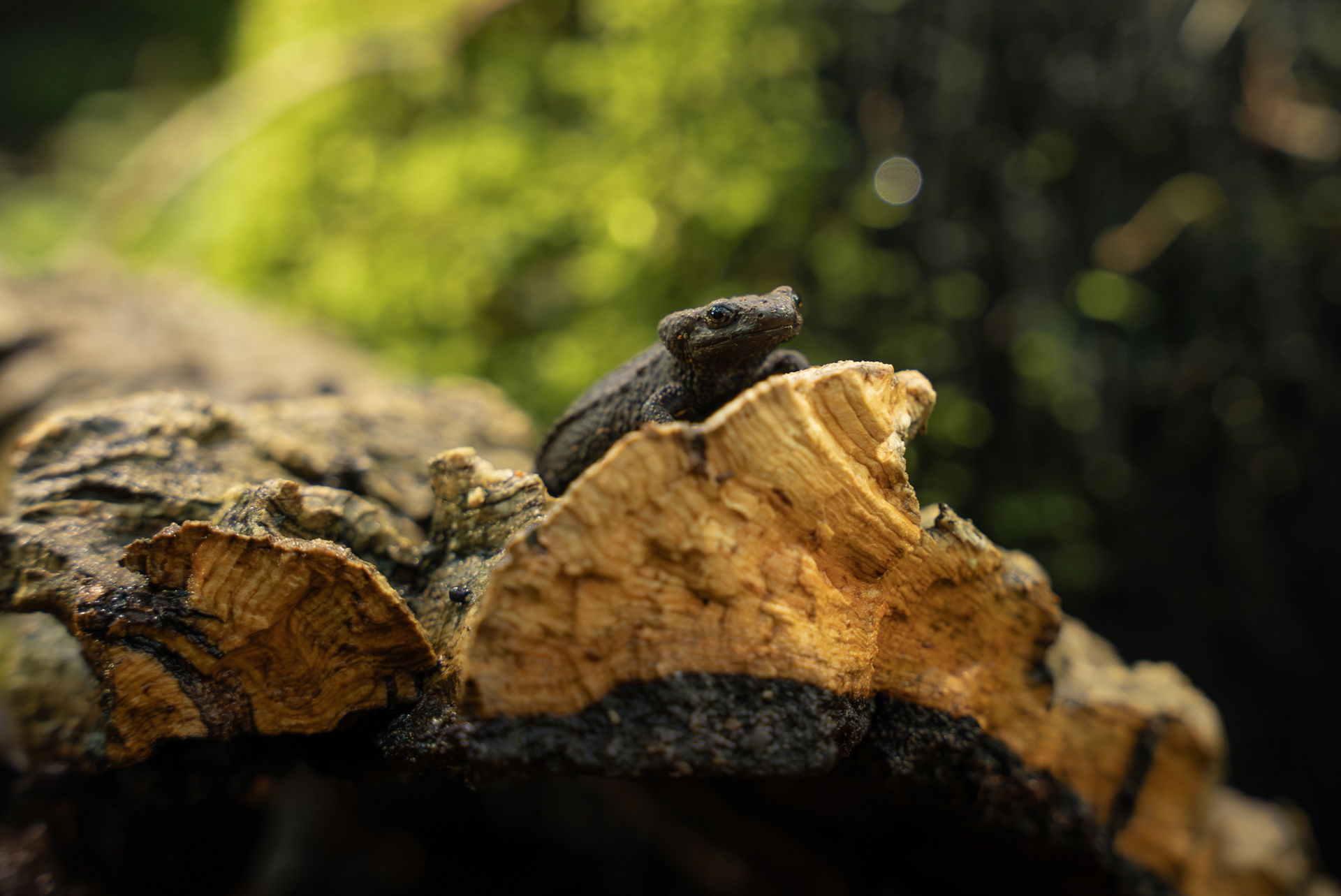
Ziegler’s knobby newt is a rather inconspicuous caudate with a black, brown, or gray base coloration. In sharp contrast, the underside of the tail and the tips of the fingers and toes are orange-red. Orange markings are also rarely found on the back. Characteristic of the genus are the three warty, longitudinally running, well-defined dorsal ridges and the two large ear glands on the rear sides of the head.
This species is a ground-dwelling animal found in the dense, subtropical rainforests of northern Vietnam and the adjacent southern regions of China. It lives very secretively under rocks and in other hiding places and is rarely found on land. Reproduction is closely tied to the rainy season, as suitable spawning waters only form then. The females lay their eggs in a mass near bodies of water. Only after hatching are the larvae washed into the water by rainfall. The larvae are golden-yellow to brownish in color and have golden spots. Their orange external gills, which regress during metamorphosis, are also easily recognizable. Their diet consists of small invertebrates such as worms, isopods, insects, and snails.
Ziegler’s knobby newt is known only from a very small range and is considered endangered. The species depends on forests, which are increasingly being cleared in its native range to make way for agricultural land. Mining and the decline of temporary small water bodies, which are important for reproduction, also have a major impact on the species’ survival.
By housing this species at the Zurich Zoo and other facilities, the goal is to conserve the species in human care. The long-term goal is to potentially reintroduce the species into its natural range through partner organizations.
Taxonomy
family Salamandridae, genus Tylototriton (approx. 43 species)
Habitat
in the humid mountain forests of northern Vietnam and neighboring China
Behaviour and ecology
lives very secretly under rocks and in other hiding places