20.09.2026 — Mithelfen
Instructions: Build an insect hotel
You can easily build your own insect nesting structures—“insect hotels”—with little effort or expense: stones, small reeds, clay, wood, and other materials can be used to create valuable habitats. This promotes biodiversity. Once the nesting aids are built, all it takes is a little patience before “hotel guests” such as bumblebees, parasitic wasps, and wild bees move into their new home.
Nesting aids for wild bees made from hollow stems
Let's get started:
Material:
Bamboo tubes (inner diameter 3–10 mm) or reed mats (available at hardware stores)
Saw or pruning shears
Wire
String
Possibly a drill
Possibly perforated bricks
Building Instructions:
Cut through the bamboo stalks behind the knot or cut the reed mat to a length of about 30 cm, taking care not to crush the stalks.
Remove the loose pith from the bamboo using a drill or wire.
Tie the bamboo tubes together with the knot facing backward, or place them individually into the holes of a perforated brick or roll up the narrow reed mats and carefully tie them together.
Find a suitable location that is protected from direct weather exposure. Locations facing southeast to southwest are ideal.
Attach the bundle or the filled perforated brick horizontally to a wall or a post.
Nesting aids for wild bees made from logs or branches
Let's get started:
Material:
Dry logs or thick branches (e.g., ash or oak)
cordless drill
drill bits 2–10 mm
string or wire
Building Instructions
Saw the wooden logs into pieces 11–15 cm long.
Drill holes of varying depths (5–10 cm deep) through the bark from the outside (2–10 mm in diameter).
Clean out the holes and sand the openings smooth.
Find a suitable location that is protected from direct weather exposure. Locations facing southeast to southwest are ideal.
Attach the perforated pieces of wood horizontally to a wall or a post.
Nesting aids for bees that nest in steep banks
You can also recreate the clay walls found along riverbanks. Sandy clay—or loess—from a construction site is ideal. Alternatively, buy ordinary clay and mix it with sand and a little sawdust in a ratio of approximately 1:3. Pack the clay into a suitable box. The resulting “wall” must not be too hard. You can also pre-drill a few holes to help the bees get started.
General construction tips
Drill parallel to the wood grain—not between the growth rings, but at right angles to them.
Make sure that all holes are smooth. Cut stems must not be frayed either. Use sharp drill bits or secateurs to prevent fraying.
Do not use plastic tubes, as they encourage mould growth.
Do not use bricks as nesting holes, as their holes are far too large. However, bricks can be used as holders for tubes.
Good to know
Not all wild bee species use above-ground nesting aids; almost two-thirds nest in the ground. Providing nesting sites alone is therefore not enough to save endangered wild bee species. Nevertheless, nesting aids offer excellent opportunities to observe nature and help raise awareness, especially among children.
Sustainable protection of wild bees—particularly endangered species—can only be ensured through the long-term preservation, care and promotion of natural or near-natural nesting sites and feeding habitats. Protecting their habitats must therefore be the highest priority.
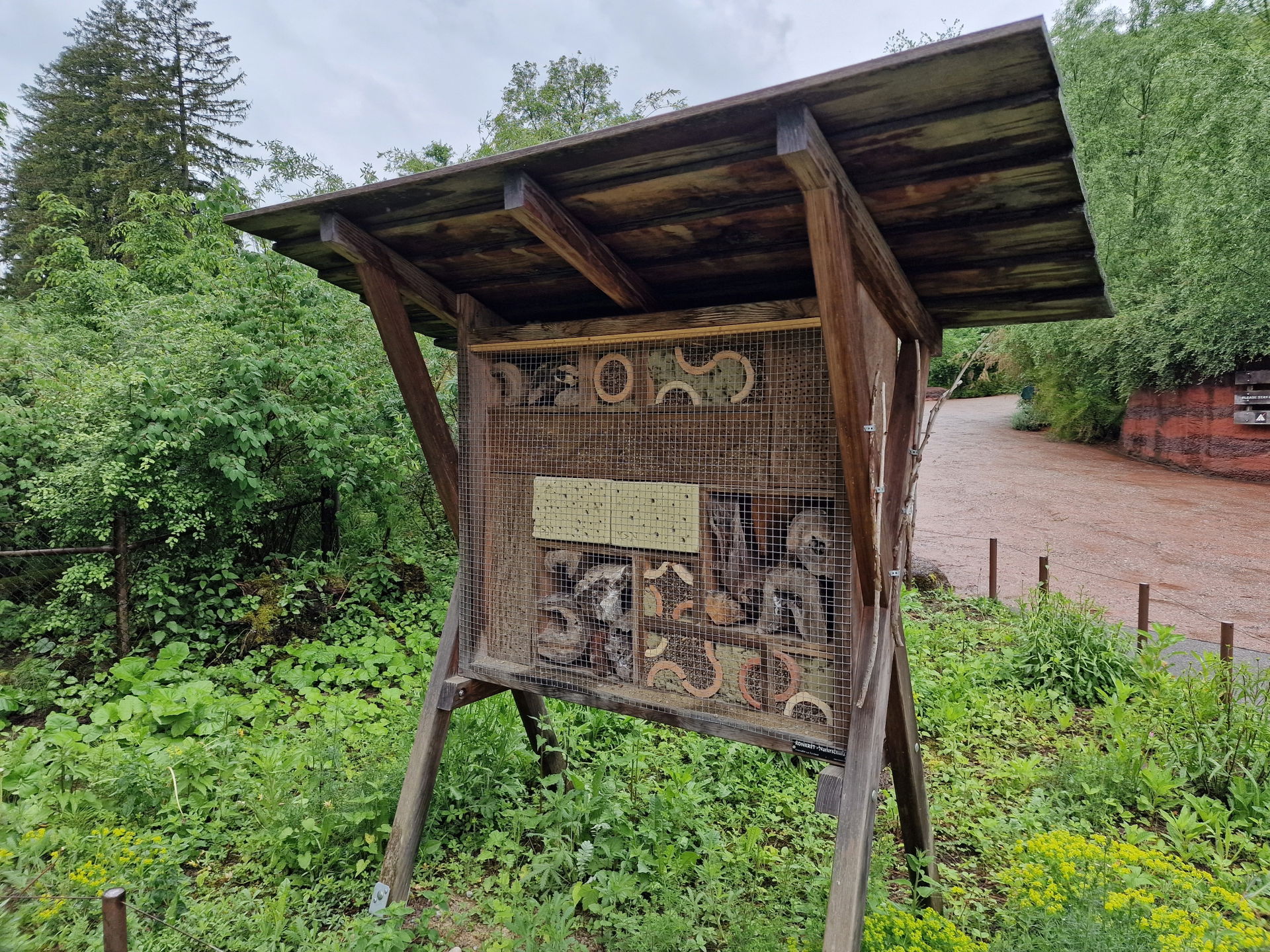
At the Zoo, an insect hotel for wild insects stands next to the Australia habitat. Image: Zoo Zurich, Sandro Schönbächler
- Education
- Research
- Species Conservation
 HabitatsWe protect nature – locally and globally