20.09.2026 — Mithelfen
Instructions: Make seed balls
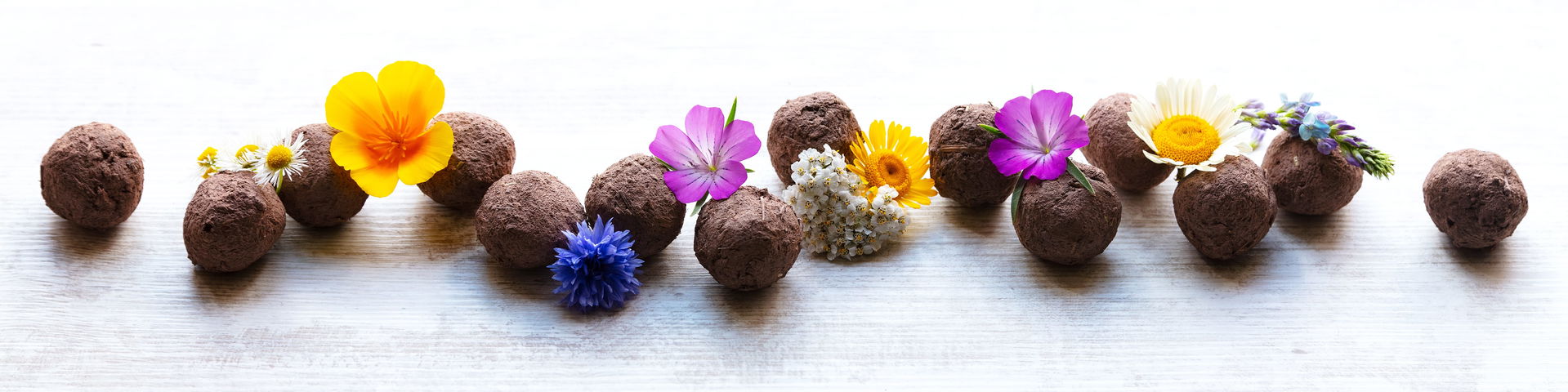
Distribute homemade seed balls containing valuable wildflowers to create new sources of food for insects. Especially in urban areas, this is a great way to support bees and butterflies.
Materials
1 bowl
1 tablespoon
Garden soil
Clay powder (available from pharmacies)
Native seed mixture (see the list of suitable plant species below)
Empty egg carton
Instructions
Mix 2 tablespoons of garden soil with 1 tablespoon of clay powder.
Add 1 tablespoon of seed mixture.
Add 2 tablespoons of water.
Mix everything thoroughly.
Shape four seed balls and place them in the empty egg carton to dry for around 3 days.
Give the seed balls away or distribute them yourself in spring, for example in your garden.
Only use the seed balls where you have permission to do so. Please do not scatter them in other people’s private gardens, nature reserves or agricultural areas.
Suitable plant species
Willowleaf oxeye (Buphthalmum salicifolium)
Field marigold (Calendula arvensis)
Cornflower (Centaurea cyanus)
Brown knapweed (Centaurea jacea)
Greater knapweed (Centaurea scabiosa)
Wild carrot (Daucus carota)
Carthusian pink (Dianthus carthusianorum)
Field scabious (Knautia arvensis)
Oxeye daisy (Leucanthemum vulgare)
Common bird’s-foot trefoil (Lotus corniculatus)
Vervain mallow (Malva alcea)
Sainfoin (Onobrychis viciifolia)
Wild marjoram (Origanum vulgare)
Common poppy (Papaver rhoeas)
Meadow clary (Salvia pratensis)
Red campion (Silene dioica)
Ragged robin (Silene flos-cuculi)
Night-flowering catchfly (Silene noctiflora)
Meadow salsify (Tragopogon pratensis)
- Education
- Research
- Species Conservation
 HabitatsWe protect nature – locally and globally