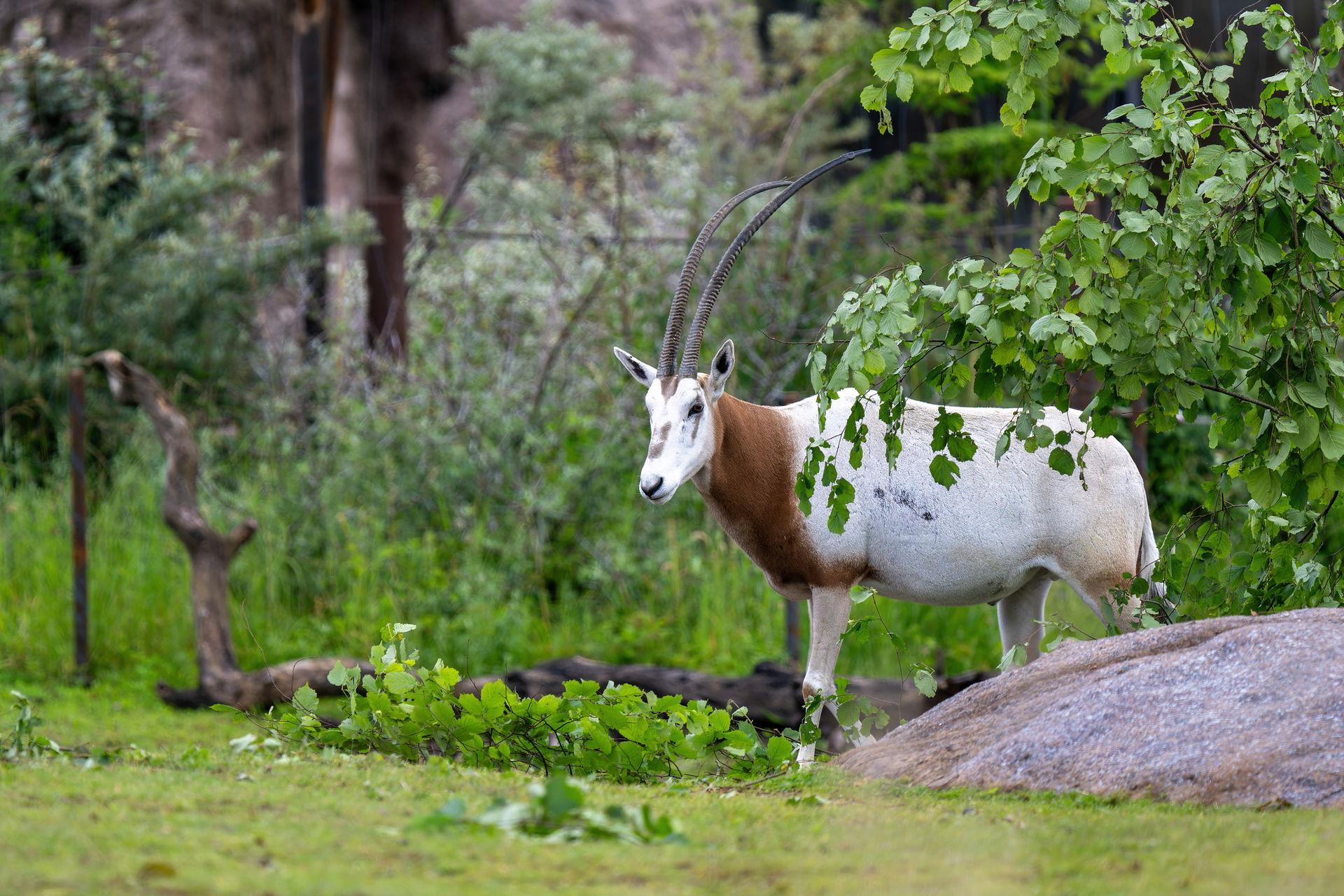
Säbelantilope (Oryx dammah) in der Lewa Savanne des Zoo Zürich

Scimitar-horned oryx

Oryx dammah

The scimitar-horned oryx was long considered to be extinct in the wild. Thanks to successful reintroduction and conservation programmes, there is now once again a growing population in its natural habitat.

EN

Red List
Endangered
Breeding programme

Scimitar-horned oryx are among the best-known antelopes in Africa. As far back as ancient Egypt, these antelopes with their long, curved horns were kept in a semi-domesticated state as sacrificial animals. 

Until recently, the scimitar-horned oryx was considered ‘extinct in the wild’. The main factor behind this status was hunting. It is therefore not surprising that the largest population of these animals now lives on and is bred on hunting farms. 

Thanks to reintroduction projects in Chad, the scimitar-horned oryx have successfully re-established themselves and are breeding. As a result, the population of wild animals is growing slowly but steadily, and a self-sustaining wild population appears to be establishing itself. 

Taxonomy

Bovidae, Oryx (6 species)

Habitat

semi-deserts

Behaviour and ecology

diurnal, foraging in areas with fresh vegetation

Social structure

in herds of 10 or more animals; depending on the food supply, they may gather together or spread out
Habitat at the zoo:

Lewa Savanna
Young animals
05.02.2026
20.02.2026
Taxonomy

Bovidae, Oryx (6 species)

Habitat

semi-deserts

Behaviour and ecology

diurnal, foraging in areas with fresh vegetation

Social structure

in herds of 10 or more animals; depending on the food supply, they may gather together or spread out

Habitat at the zoo:

Lewa Savanna

Godparent

Support the animals of Zoo Zurich with your annual godparent sponsorship

Scimitar-horned oryx for CHF 1'000.–

Become a godparent

Godparent

Support the animals of Zoo Zurich with your annual godparent sponsorship

Scimitar-horned oryx for CHF 1'000.–

Become a godparent
Back to overview