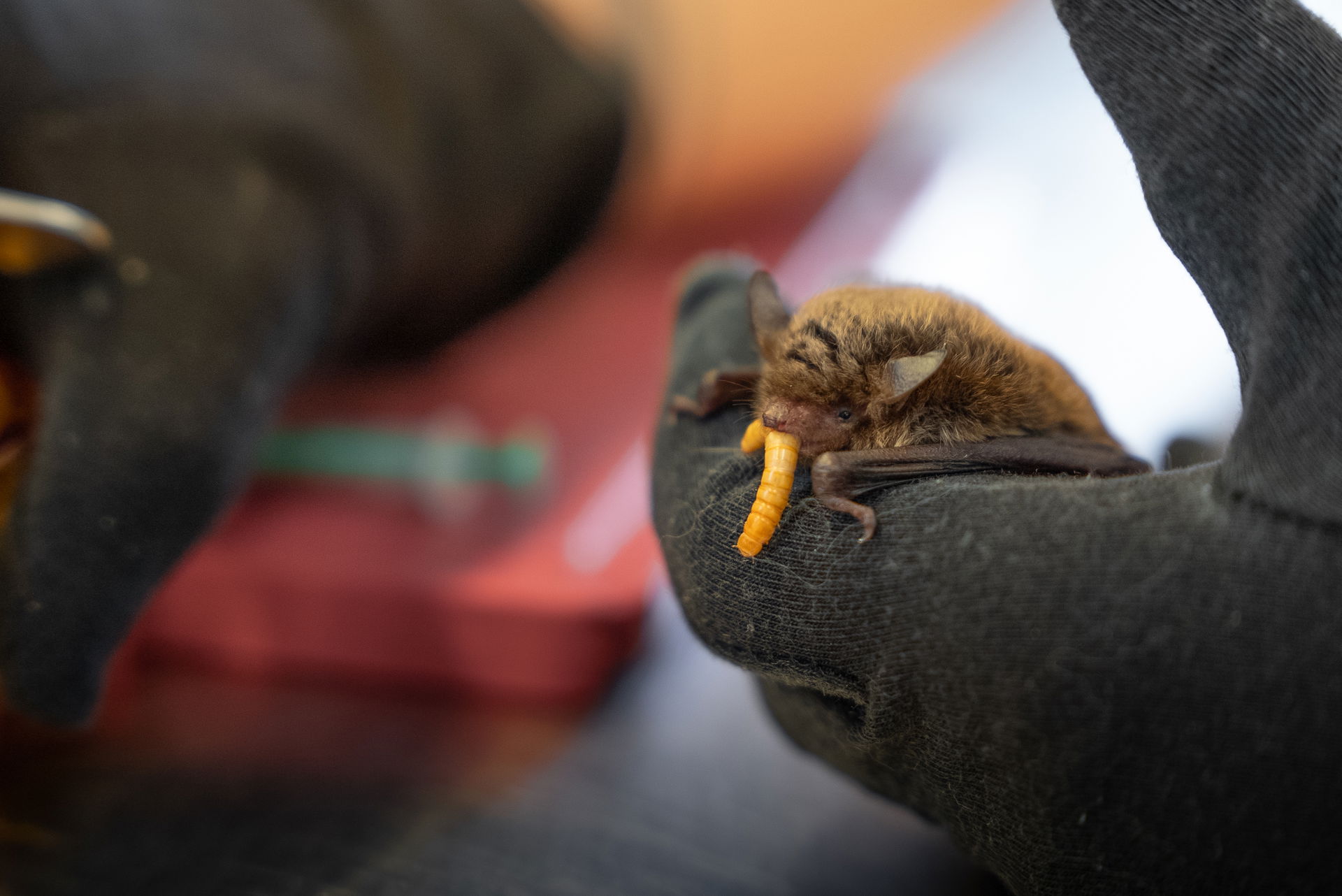
Conservation project in the field
Bats
There are thirty native bat species in Switzerland—half of them are endangered. With this project, we want to help them.
Since 1998, we have been hosting the Bat Conservation Foundation at the zoo. This includes spaces for both the foundation’s informational and educational work and for its activities as the Swiss Coordination Center for Bat Conservation. In addition, together with the Bat Conservation Foundation and Zurich Animal Welfare, we operate the bat emergency care station at Zoolino.

The Bat Conservation Foundation coordinates bat conservation efforts in 19 cantons on behalf of the federal government. Through its educational and outreach programs, it works to foster long-term support for threatened native bat species. Through its educational efforts, the foundation has laid the groundwork for broad acceptance of the urgently needed bat conservation measures. Through its training and continuing education programs, the Foundation has also worked with the cantonal bat conservation coordinators to build a team of more than 600 volunteer bat conservationists active at the local level.
Get involved
Become part of our bat conservation project. We promise that every franc donated will go entirely toward the project.

There are 30 species of bats living in Switzerland. Of these, 15 are at risk or even threatened with extinction. Since they inhabit different habitats, the causes of these threats are varied.
The demolition of old buildings, the conversion of attics, and new, compact building envelopes that offer no shelter are depriving bats of their hiding places. In addition, there is a shortage of old-growth forests with tree cavities in the woods.
Project facts
1998
we began our commitment to bats.
1.78million
CHF in direct contributions have been made possible for the project to date.
Humans also disturb bats during their flights—which often span several kilometers—from their daytime roosts to their hunting grounds: Roads fragment the landscape, and this is compounded by noise pollution, urban sprawl, and light pollution.
Because wetlands are disappearing, agricultural land is being used more intensively and has become more monotonous, and because evergreen, common plants are replacing insect-rich native species in private gardens, there is an increasing shortage of insects in bats’ hunting grounds.
Last but not least, pesticides have a severe impact on bats. The toxins are passed on to the next generation of bats through their mothers' milk.
Video: Zoo Zurich, naturemovie.ch
- Education
- Research
- Species Conservation
 HabitatsWe protect nature – locally and globally
Your donation to the bat conservation project
