21.10.2026 — Tiere
Complex Amphibians
In his column in the *Tagblatt der Stadt Zürich*, zoo director Severin Dressen shares stories — both big and small — from everyday life at the zoo. This time, he discusses how first impressions sometimes reveal only half the truth.
Once upon a time, there was a spiny crocodile newt. It lived with many other spiny crocodile newts in the subtropical forests of northern Vietnam and southern China. There, it reproduced and led a safe life. The story could end right here. But it doesn’t. Because nature shows us time and again, in a striking way, that it is more complex and exciting than we often realize.
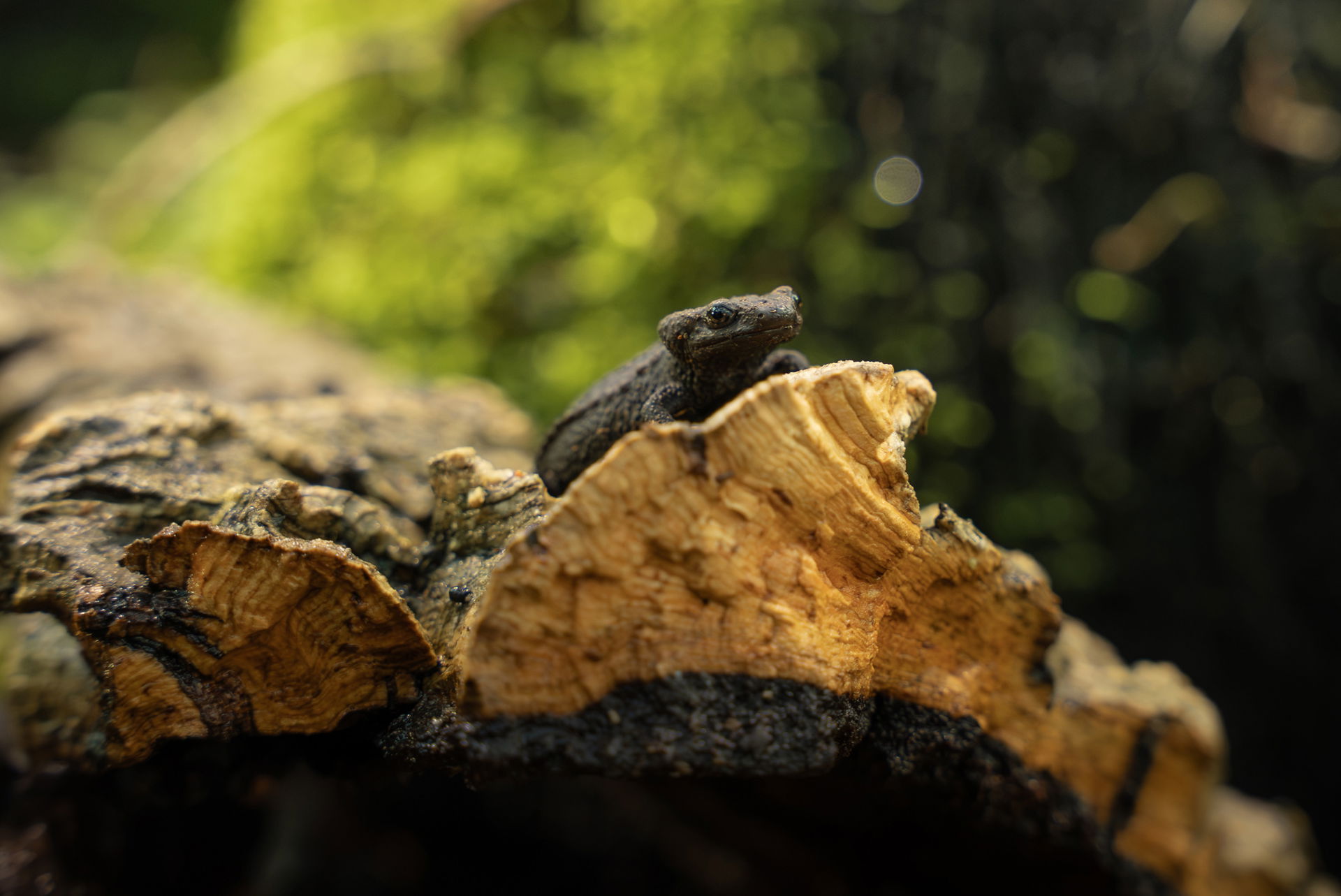
Ziegler’s knobby newt at Zoo Zurich. Photo: Zoo Zurich, Tim Benz.
Different Genes, Different Species
This was also the case here. Starting around the 2000s, molecular genetic methods became easier to apply to the study of species. Their increased use in conjunction with field research then led to some surprises, including in the case of the Black Knobby newt (Tylototriton asperrimus). Behind this supposedly “single species” lay several distinct species. One of them did not receive its scientific name until 2013: Ziegler’s Knobby newt (Tylototriton ziegleri). Experts refer to this phenomenon as “cryptic diversity.” Cryptic species look so similar that they are long mistaken for the same species. Only modern research methods reveal the hidden differences.
This may sound like academic hair-splitting, but it has major implications for species conservation. That’s because a supposedly common species suddenly becomes a multitude of specialized species with small ranges and, often, significantly higher risks of extinction. This also applies to Ziegler’s crocodile newt. At first glance, the newt seems rather unremarkable. Only upon closer inspection do its orange-red fingertips and toe tips catch the eye. Such striking colors often serve as a warning signal. They can signal to potential predators: Beware—I’m not to be trifled with.

The red tips of its toes serve as a warning to potential predators. Photo: Zoo Zurich, Tim Benz.
Rain Brings New Life
The newt’s reproductive strategy is also surprising, as it has allowed it to adapt perfectly to its habitat. The species now exists only in small populations in a few moist mountain forests of northern Vietnam and in neighboring China. In these areas, small bodies of water often form only during the rainy season. Unlike many amphibians, the female therefore does not lay her eggs directly in the water. Instead, she deposits them in damp spots. Only the hatching larvae are then carried by heavy rains into newly formed small bodies of water, where they continue their development. A clever strategy of nature, but one that works only as long as such niches exist. Deforestation and mining are causing the newt’s specific habitat to shrink increasingly. And so, shortly after its discovery, Ziegler’s crocodile newt was already considered endangered.
Recently, 16 animals that are part of an international reserve population have also taken up residence at the Zurich Zoo—an important step toward the long-term conservation of the species. This doesn’t mean the species is saved forever. But it does mean its chances of a fairy-tale happy ending are at least a lot better.

Photo: Zoo Zurich, NIKON Claudio Thoma.
Obenstehender Text erschien erstmals im Rahmen der Kolumne «Zoo Intern» von Severin Dressen im «Tagblatt.